
Introduction
If you have heard the term “somatic touch work” and wondered what it means, you are not alone. It is one of those phrases that gets used in wellness spaces without much explanation, and the explanations that do exist tend to be either too clinical to make sense of or too vague to be useful.
The short answer: somatic touch work is a form of intentional, trauma-aware physical contact used within a therapeutic relationship to help the nervous system complete physiological processes that words alone cannot reach.
I am a Somatic Experiencing Practitioner (SEP) and Somatic Educator and Bodyworker. Touch has been a central part of my own recovery and of the work I do with clients. This is my attempt to explain what it is, why it works, and why it is not the same as massage.
Why Touch is Important to the Nervous System
To understand somatic touch work, you need to understand something about how the mammalian nervous system evolved.
We did not come into the world with fully formed, independent physiologies. A newborn cannot regulate its own internal states. It cannot bring its heart rate down after a scare, settle its own stomach, or shift out of a panic response. What it has, instead, is a caregiver.
The nervous system of a baby is wired to look for external regulation. A mother’s heartbeat, the warmth of skin against skin, the pressure of being held, the slow rhythm of rocking: all of these are not comfort in a sentimental sense. They are biological inputs that the immature nervous system uses to calibrate itself. The caregiver is, literally, functioning as the baby’s soothing system until the baby’s own system is developed enough to take over that job.
This is not a metaphor. It is structural. Babies arrive with what you might think of as the most primitive layers of their nervous system already online, the parts that slow everything down in response to threat. The newer, more social layer, the one that allows for calm engagement, play, connection, and self-soothing, comes online over time, and it comes online through contact. Through the eyes of a caregiver looking back. Through the hands of someone whose own nervous system is settled. Through physical presence.
A baby does not learn that the world is safe by being told it is safe. It learns through repeated physical experience with a regulated other.
What This Means for Adults Who Carry Old Stress
When early experiences of contact were absent, unpredictable, or frightening, the nervous system does not just remember that emotionally. It encodes it physiologically. The body learns, at a level beneath language, that contact is dangerous, or that closeness requires bracing, or that being held means waiting to be released.
These patterns do not vanish because you understand them. That is not how implicit physiological learning works.
Years of therapy can give someone extraordinary insight into their patterns, their history, their relational dynamics. And the body can still respond on its own schedule: flooding, shutting down, tensing up, going elsewhere, even when the cognitive mind has long since caught up.
The same thing happens with stress responses that never completed. The mammalian nervous system evolved to physiologically resolve stress in a specific cycle: mobilize, discharge, return to baseline. When that cycle gets interrupted, which is common in complex or developmental trauma, the physiological activation does not simply disappear. It stays in the tissue. In the jaw, in the diaphragm, in the pelvic floor, in the shoulders that have been up against your ears since 2009 and that you have come to think of as just your body now.
The story behind the tension is often not what moves it. The sequential expression of that energy in the tissue does.

What Somatic Touch Work Actually Is
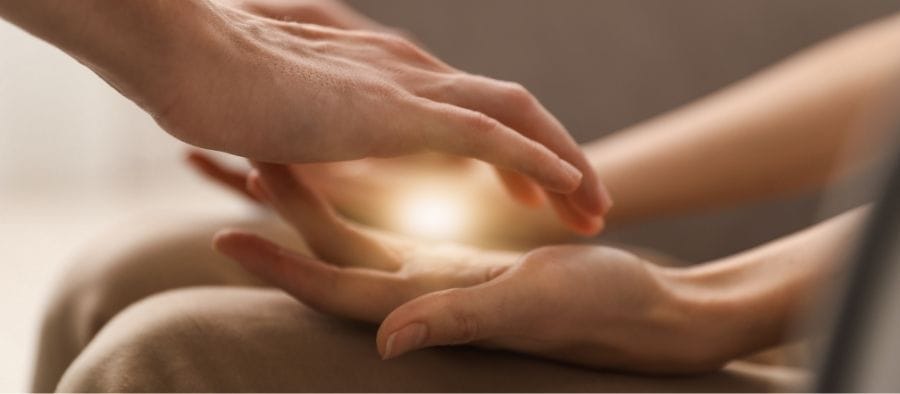
Somatic touch work uses gentle, often non-manipulative, intentional physical contact to engage directly with that physiological layer.
In a session, touch is not passive or procedural. It is not the same as massage, where the practitioner has a plan and executes it on you. In somatic touch work, the practitioner is listening through their hands, tracking what is happening in the tissue and in the broader system, noticing what shifts and what braces and what starts to organize differently when contact is introduced.
The kinds of touch used depend on what the client’s system needs at any given moment. Some contacts are containment-oriented: a steady hand on the upper back or sternum that helps a flooded system locate its edges again. Some are listening contacts: hands resting in stillness on a shoulder or a knee, not trying to change anything, just present. Some support movement that is trying to happen. Some slow something down that is escalating.
What distinguishes this from bodywork in the conventional sense is not the placement of the hands. It is the quality of attention behind them. A skilled practitioner is tracking several things at once: the client’s breath, the client’s tissue state, subtle color changes in skin, micro-movements, and their own internal signals. The contact is responsive. It follows the client’s system, not the practitioner’s agenda.
Consent is non-negotiable. Permission is asked before each contact. The client can adjust, redirect, or stop anything at any time. For people who carry a history of their body being overridden, that structure is not a formality. It is part of what makes it possible for the nervous system to begin taking in contact differently.
Why This Is Different From Talk Therapy
Talk therapy is an extraordinarily useful tool for some things. Making meaning of experience, processing grief, developing insight, navigating relationships: all of that can happen in a conversation.
What it cannot do is directly address physiological patterns that are running below the level of narrative.
When your diaphragm is braced, telling you about the brace does not usually unbrace it. When your jaw has been clenching since you last had to hold it together in front of someone who could not handle your falling apart, understanding that intellectually does not tell your masseter anything. When your nervous system learned that relaxation is a vulnerability, no amount of “you are safe now” will override that learning, because that learning is not stored in the part of the brain that processes language.
The nervous system learns through experience. Specifically, it learns through repeated contact with a regulated system outside of itself. First through caregivers. Later, potentially, through a practitioner whose own system is settled enough to be a resource.
This is not magic. It is biology. The mammalian nervous system is built to find and develop its bearings from other mammals to survive…and thrive.
What Happens in a Session
A somatic touch session with me looks different from what most people expect.
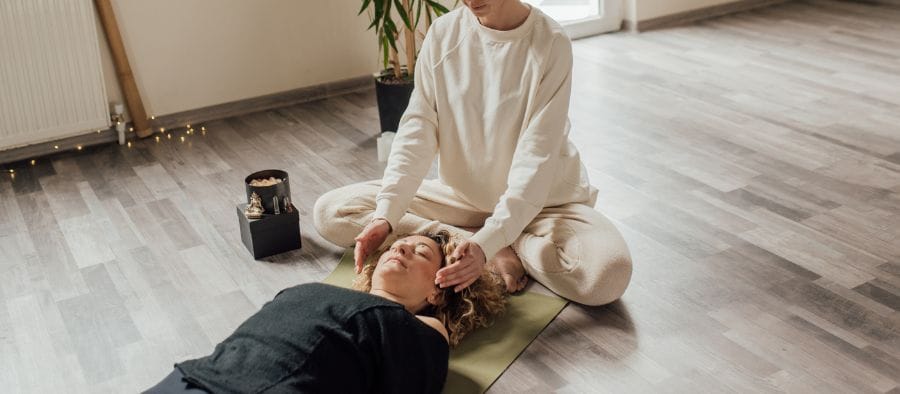
You stay fully clothed. We usually begin with a conversation, tracking what is present and establishing where your system is starting. I will ask about sensation in your body, not your thoughts about your body, but direct, present-moment contact with your physical experience: what is in your chest, your throat, your low back, your feet.
If and when touch becomes part of the session, I will ask permission. I will explain where I am thinking of placing my hands and why, and you will tell me whether that feels workable. Nothing moves forward without a yes from you.
The touch itself is usually still. A hand on a shoulder. Contact with the base of the skull. A palm against the sacrum or sternum. I am not doing anything to you in the conventional sense. I am present, attending, and noticing what happens when contact is introduced to a place that has been bracing, guarding, or going numb.
What clients often notice is something quiet and unexpected: a breath that drops somewhere lower than it has been, an ease in the throat, warmth spreading through an area that has felt cut off. Sometimes there are tears, not from being overwhelmed, but from something organizing. Sometimes the experience is simply one of not having to brace anymore for a moment, and noticing that that is possible.
The work is slow by design. The nervous system does not change through intensity. It changes through repetition of a new experience: contact is not a threat. Presence is not a demand. You do not have to perform or manage yourself here.
Who This Work Is For
Somatic touch work is particularly relevant for people who:
- Have done significant cognitive or emotional work and still find their body responding outside of their conscious control
- Find that traditional therapy does not work for them
- Carry a history of complex, developmental, or relational trauma, particularly trauma that happened early, before language, or in the context of close relationships
- Experience chronic physical tension, pain, or body symptoms that have not resolved through conventional approaches and that seem connected to stress or history
- Find that they disconnect from their body in stressful situations, or conversely, that they cannot settle
- Have a complicated relationship with physical contact, either avoiding it or seeking it in ways that feel compulsive rather than nourishing
This is not a replacement for other forms of care. I am not a therapist. Somatic touch work often sits alongside other support, not instead of it, and for anyone navigating significant mental health presentations, it works best as part of a broader care team.
Frequently Asked Questions
No. Massage typically has a defined protocol and works with muscle tissue in a hands-on, procedural way. Somatic touch work is relational and responsive: it follows your system rather than executing a plan on you. The quality of attention and the therapeutic relationship are central to how it works. Clothing stays on. Sessions include verbal tracking, not just physical contact.
No. Touch is one tool, not the whole framework. Many clients do significant somatic work with very little or no physical contact, using attention, breath, movement, and verbal tracking instead. If touch is introduced, it is always with your permission and at a pace your system can tolerate.
The distinction between psychological and physiological is less clean than we tend to assume. Trauma is stress that did not complete its physiological cycle. The patterns that result are not stored only in narrative memory. They are encoded in tissue tone, in autonomic responses, in the way your breathing organizes around an old threat. Touch can reach those patterns in ways that words cannot, not by bypassing the mind, but by working with a layer the mind does not fully govern.
This is one of the most common concerns people bring into this work. The short answer is yes, with care, with pacing, and with your nervous system in the lead. People with complex touch histories often find that working slowly with somatic touch in a safe therapeutic relationship is one of the few things that actually begins to shift their relationship with physical contact. That said, this work requires a practitioner who is specifically trained in trauma-aware touch, not just touch-aware practitioners.
Somatic therapy is a broad category. Somatic touch work specifically refers to approaches that incorporate intentional physical contact as part of the therapeutic process. Not all somatic therapists use touch. My work draws from SE, NATouch, SSE, and TST, all of which include touch as a distinct clinical element when appropriate.
This varies considerably depending on what you are working with, how your system responds, and how much access to regular sessions you have. For complex or developmental presentations, this is not short-term work. Most clients notice something shifting within the first few sessions. Consolidation takes longer.
Work With Me
I work with clients one-to-one in Toronto and internationally online. I offer intensives both in my space (you travelling to me), or your space (bringing me to you), for people who want more concentrated work over a shorter window. I am a Somatic Experiencing Practitioner (SEP) and Somatic Educator and Bodyworker with years of advanced complex and developmental trauma training, and I currently have space for new clients.
If you are curious whether this kind of work might be relevant to your situation, a free 15-minute consultation is the best place to start. We can look at what is going on for you and whether somatic touch work makes sense as part of your recovery and to support you in building a life worth living.